SceneFiend library
Romeo and Juliet
By William Shakespeare - Stage play
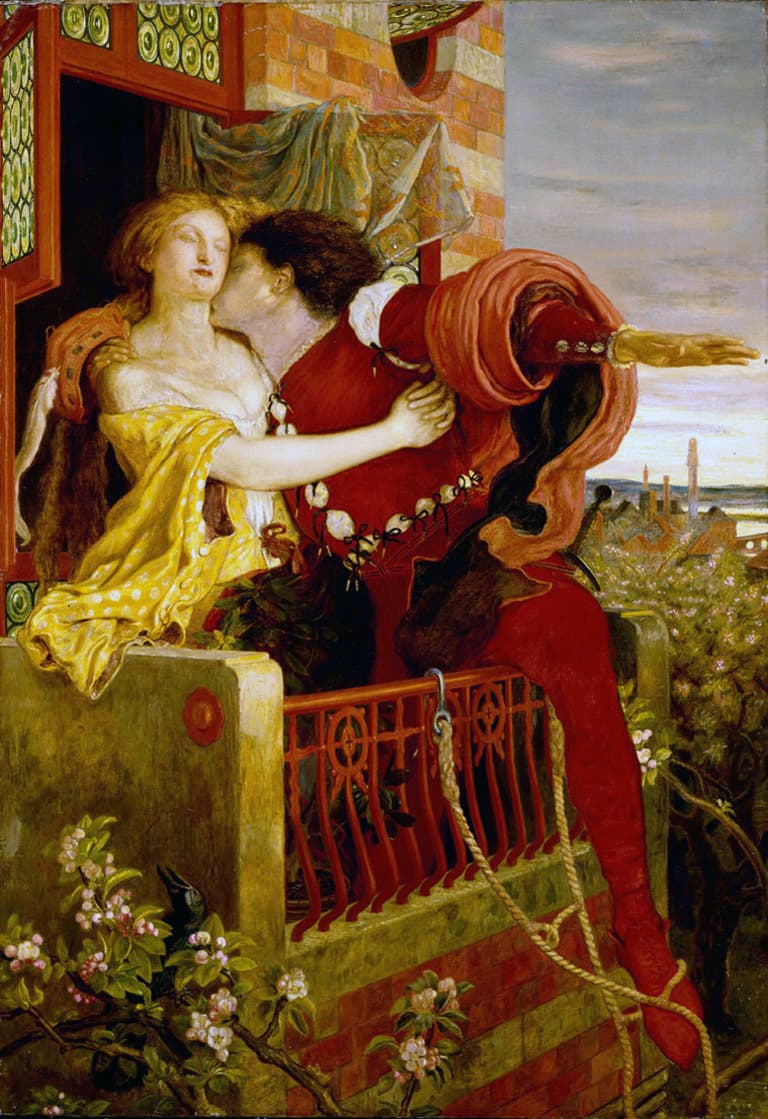
Ford Madox BrownPublic domainWikimedia Commons
Roles
- Romeo - Teenager (13-19), Young Adult (20-35), Male
About this piece
Romeo sees Juliet at her window
Summary
In the city of Verona we find two quarreling families, the Montegues and the Capulets. Romeo belongs to the Montegue family and Juliet to the Capulets. In this first scene of the play a fight takes place between servants and kinsmen of the two families until the Prince of Verona stops them. Benvolio runs into his cousin Romeo who tells him he is in love with Rosaline who has sworn to live a life of chastity and therefore does not return her love. Benvolio advices him to forget about her but Romeo won't listen to him. The Capulets throw a masquerade party at their house. Capulet, the father of the Capulet family asks Paris, a kinsman to the Prince, to meet his daughter Juliet at the party and court her. He wants him to marry her but wait at least two years since she is thirteen years old. Mercutio convinces his friend Romeo to join him and his friends at the Capulet party. Romeo is reluctant but then accepts to go. There he meets Juliet and instantly falls in love. He meets her and they kiss. Tybalt, Juliet's cousin, notices that they are at his party and wants to start a fight but is stopped by Capulet. Romeo and his friends leave the party but then Romeo decides to go back and meet Juliet again. He climbs into the Capulet's orchard and there he sees Juliet at the window. In this monologue, in ACT II, Scene 2, he admires Juliet's beauty.
Tone
Use cases
Library metadata only. SceneFiend never includes script text here - pick up the published version to rehearse.
Similar pieces
- The Jew of Malta
By Christopher Marlowe
Shares same format: monologue, stage piece, Renaissance.
- Agamemnon
By Aeschylus
Shares same format: monologue, stage piece, solo.
- An Angry Rant of a Banished Prince
By Vathara
Shares same format: monologue, stage piece, solo.
- Cain
By Lord Byron
Shares same format: monologue, stage piece, solo.